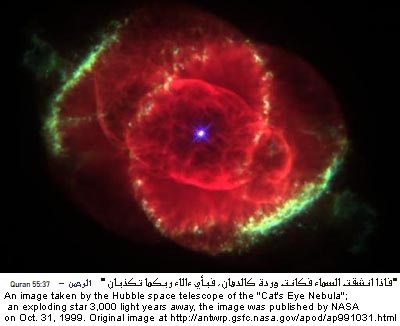
|
The 9/11 Israeli Lie:
Daniel 11:45:
"(the
evil one) will establish his settlement between Mount
Zion (Jerusalem) and
the Mediterranean
sea. Then
he will be
destroyed, and no one will be able to save him."
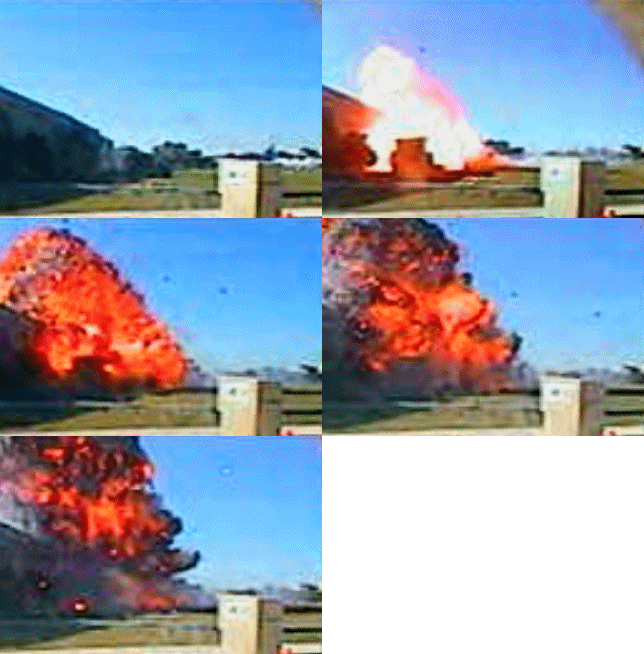
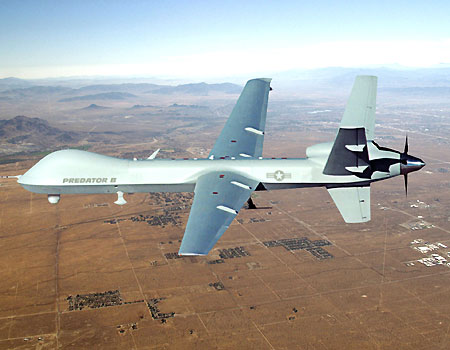


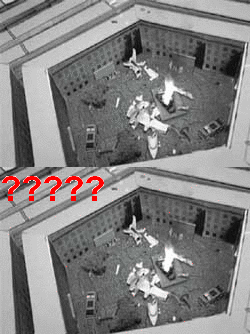
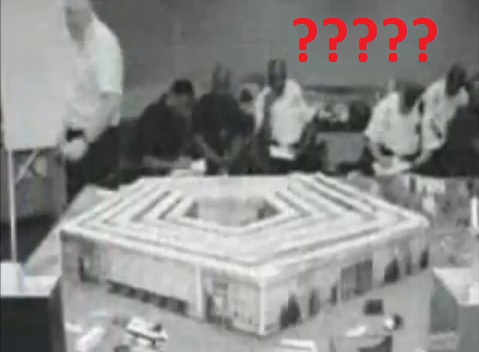
(Video)
9/11 was 100% an Israeli lie
See also
Isaiah's
prophecy about the
Jews will worship the pornographic
goddess Asherah
during the end of times.
Daniel 11:45:
"(the
evil one) will establish his settlement between Mount
Zion (Jerusalem) and
the Mediterranean
sea. Then
he will be
destroyed, and no one will be able to save him."
To all of Israel's holy
toilet papers out there: The geography in
Daniel 11:45
is precisely evil Israel today. With your blood, wealth, and children's
blood and wealth you plot, and fight and die for its evil cause against the
Palestinians and the rest of the Muslims
(Isaiah
56:5: Muslim is the future believers' name.
Sons and daughters titles will be "no
more"); the true believers
of GOD Almighty.
9/11 was 100% an Israeli mossad and CIA job.
Jesus in
Matthew 24
referenced Daniel 11. The headquarters of the evil shepherd will be from
Jerusalem to the Mediterranean sea.
Jesus will return from Arabia
according to the NT. Jesus also had
great respect to Palestinians and Arabs in NT. Both OT and NT
praise
future Arabs as the True Believers of GOD
(Luke
2:52:
GOD forgave Jesus' sins
and was "charitable" with him) .
9/11 was 100% an Israeli lie.
Keep in mind also that the
final Prophet from Arabia in Jeremiah
31:31–32, Isaiah 42:10-13, John 1:19-21 and John 7:40-44 will
bring a new
covenant different from
the one given
to Moses
("It
will not be like the covenant I
made with their ancestors"),
and he will be a gentile. Only Islam's Covenant and Prophet fulfilled
this.
Habakkuk 2:15-16 GOD's cup is
against those who spoil their neighboring
nations and others. Israel is notorious in staging lies, fabricating
stories and oppressing people.
Isaiah 48:8, Psalm 58:3, Psalm 25:3 and Jeremiah 8:8 Israel from
their birth, they
are
liars.
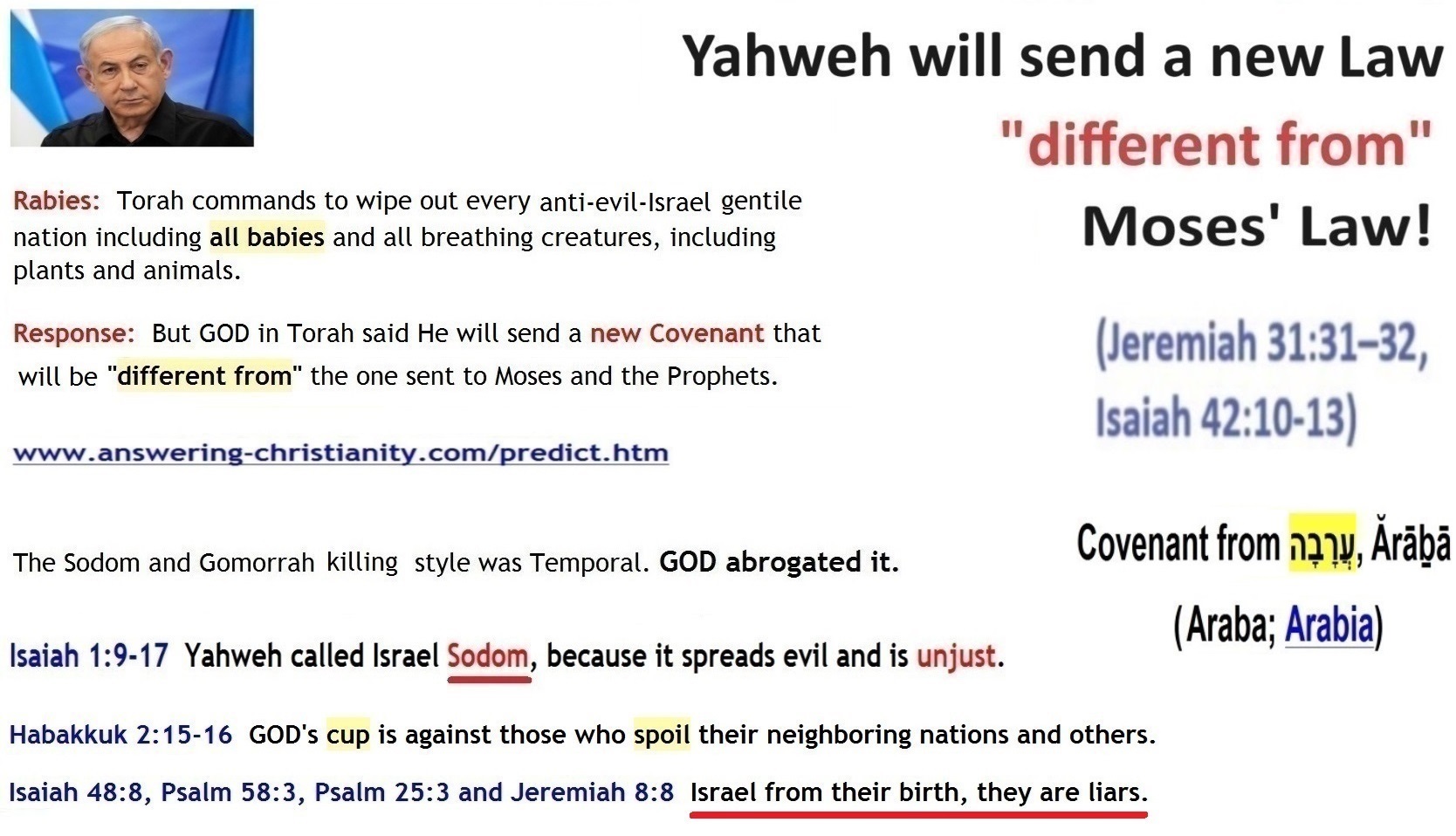
The Jews' expiring Covenant (Jeremiah
31:31–32):
Jeremiah 31:31–32
31 “The days are
coming,” declares the Lord, “when I will make a new
covenant with the people of Israel and with the people of
Judah.
32 It
will not be like the covenant I made with their ancestors
when I took them by the hand to lead them out of Egypt,
because they broke my covenant, though I was a Master to them,” declares the
Lord.
A new Covenant different
from the Covenant that was made after the Exodus of Egypt.
So it will be different from the Laws of books of Exodus, Deuteronomy,
Leviticus and
Numbers, and all of the Jewish Prophets' books,
including this book of Prophet Jeremiah's. See Bibles' prophecies about
GOD's "New
Song" and New Covenant from
עֲרָבָ֛ה, Ărāḇā (Araba;
Arabia) , and His new House will be in the desert of
Arabia, and His new Prophet will be a Gentile Prophet from Arabia. See
also:
The invaded unwalled
Israel Ezekiel prophecy by the Great Satan; not the Palestinians.
Virgin Mary is being
group-incest-raped
by some trinity members.
Also visit:
Matthew 24:25-27:
Jesus will return as an Arabian Messiah from Damascus.
Isaiah 42:10-13 GOD
will sing a New Song from
Arabia via the gentile Arabian Prophet. Read below.
|
GOD's Honorable
Burdens upon Arabia:
GOD Almighty's new
burdens that he placed on future
Arabia are the same burdens that He placed upon Prophets, and also
upon places where the righteous believers carry His Truth and uphold
it. A burden from GOD Almighty is:
1- Costly.
2- Requires endless
patience and perseverance.
3- Is an honor from
GOD Almighty upon the individual or the group of people.
4- Is
not a wrath from GOD Almighty upon the individual or
people.
Future Arabia
has many
burdens placed
upon it throughout the OT. Notice also in the Bible, Prophet
Job was called "perfect
and upright" by
GOD Almighty in the OT. He was a very rich Arab man.
Also, Jesus in the NT called the Canaanite Palestinian
woman "O woman, how great is your faith!
Be it as you wish." He never granted any wish a person
desires to any person throughout the NT, other than this Arab woman. |
Thermite melted the pillars:
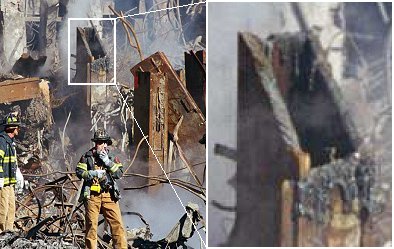 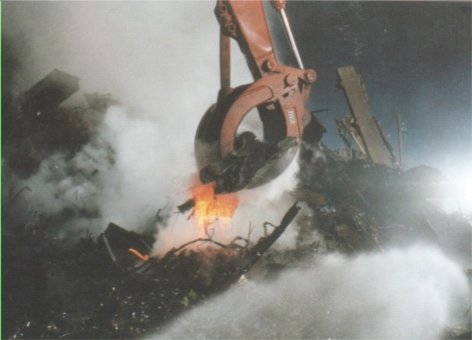 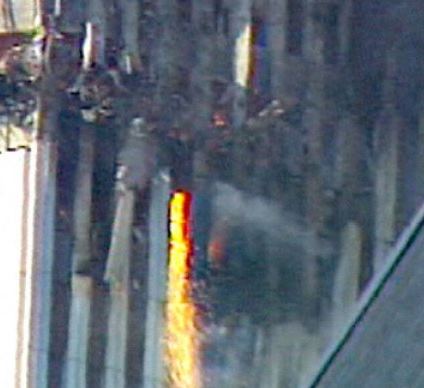
Thermite causes the metal to burn wildly,
and if you pour water on it, it will be enraged even more.
Civilian
airplanes do not carry thermite!
Thermite was used to bring down the Twin Towers on 9/11/2001 by the Israeli
Mossad and CIA.
9/11 was 100% an Israeli lie.
Daniel 11:45:
"(the evil one) will establish his settlement between
Mount Zion
(Jerusalem) and the
Mediterranean sea. Then
he will be
destroyed, and no one will be able to save him."
See also Isaiah's prophecy about the
Jews will worship the pornographic goddess Asherah
during the end of times.
Also visit: Arabia's
honorable burdens from GOD Almighty in the Bible
(Luke
2:52:
GOD forgave Jesus' sins
and was "charitable" with him).
Bibles
&
Islam:
Jesus will
kill
100s of millions when he returns.
The disciples arguing
about the Sabbath and other Laws. Jesus promised them that the
Holy Spirit will take over the disciples' mouths and that there will be no
arguments, confusions or riddles. Yet, the NT is marred with open
arguments, vilifications (calling each other cursed by GOD "anathema",
satanic, false, wrong). Where is Jesus'
promise??
Totally a false promise!
- Where is Jesus'
promise??
- He promised that the Holy Spirit will take over the disciples' mouths,
guide them in all ways, and that it will be the Holy Spirit speaking, not them.
- They ended up splitting into
Paul vs. Peter two
opposing groups, and were at odds with each other on several theological issues.
- Their differences remain unsettled till this day in the NT. They
were never resolved.
- 12th disciple was also chosen by
holy gambling.
- They were barking at
each other like rabid dogs
calling each other cursed, false,
liar, satanic, your gospel is from satan!!
[1]
Their books didn't even exist for the first 200 to 300 years, says
most Bibles theologians.
They are very highly corrupted. Also, Trinity is a lie from Hell.
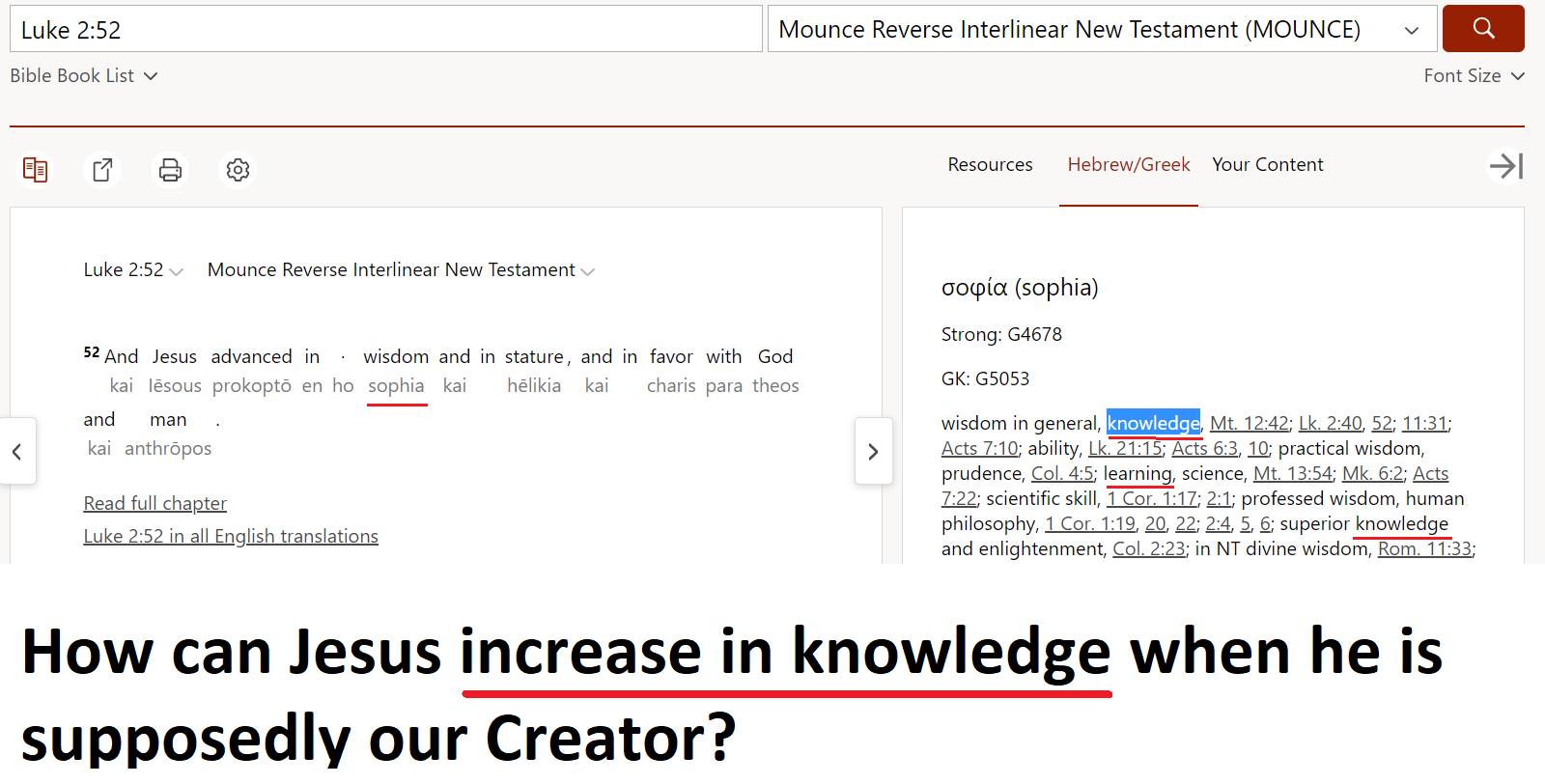
Why was GOD Almighty charitable
(χάριτι)
and forgiving to Jesus in
Luke 2:52?

Where was the promised Holy
Spirit in their conflicting
scriptures?
Remember:
Matthew 7:22-23: GOD
sent Jesus to
be Christianity's lying
spirit
Dismal Spiritual Failures:
Let us examine the following:
Romans 3:23 ESV
For all have sinned
and fall short of the glory of God,
Ecclesiastes 7:20 ESV
Surely there is not
a righteous man on earth who does good and
never sins.
No man is sinless and faultless. The NT even says Jesus himself
sinned via coveting
the sins of the world. Paul then barfs the following gem:
1 Corinthians 2:15
A spiritual man makes
judgments about all things, but he himself
is not subject
to any man's judgment.
How???
How can any flesh and blood sinner not be
subjected to judgment? The world has seen how disastrous your
pedophilic and corrupt priests, ministers and churches are, from sex
abuse on children,
theft,
prostitution and so much more. Ironically also, Paul and
the disciples themselves dismally failed this standard when they turned into
rabid dogs in harsh judgments
on each other;
calling
each other cursed, false, liar,
satanic!
[1]
Their books didn't even exist for the first 200 to 300 years, says
most Bibles theologians.
They are very highly corrupted. Also, Trinity is a lie from Hell.
Why was GOD Almighty charitable
(χάριτι)
and forgiving to Jesus in
Luke 2:52? There is also conflict regarding misogyny:
Paul proves the book of Revelation is a forgery; a book of
misogyny.
Which book were the people of the Book reciting
(فسأل
الذين يقرؤون الكتاب)
during Prophet Muhammad's days according to the Glorious Quran
10:94?
Insufficient Jesus:
Edward Dalcour says that Jesus would be insufficient if Paul was proven to be
false: 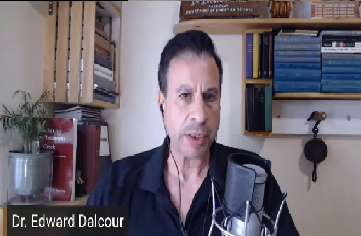
Sam Shamoun thoroughly demolishes trinity and the early bibles' writings.
See also: 24 other
thrones besides Jesus'.
Virgin Mary is being
group-incest-raped
by some trinity members.

Quran: All Bibles are
mostly
corrupt [1]
قول
(Quran 10:94 and 10s others discussed).
See also the 39+
members of
trinity.
Does Noble Verse
9:31 say that
Allah and Jesus are
two equal Lords?
Also, thorough refutation to
توحيد الربوبية (tawheed
alruboobiyyah, or
Oneness of Lordship between Jesus and Allah) concept by the polytheist
trinitarian pagans (Luke
2:52:
GOD forgave Jesus' sins
and was "charitable" with him).
***** Bibles' OT and NT:
Spirits that GOD Almighty sends down including
lying ones in the Bibles.
Jesus in several passages was Commanded by GOD to become one
to forge falseianity (christianity) because of the ample blasphemies
of the Jews.
Why was GOD Almighty
charitable (χάριτι)
and forgiving to Jesus in
Luke 2:52?
Jesus replaced Satan: (Ezekiel
28:13-19).
Notice the language of how Satan was:
1. "You were
perfect from the day you were
created". Jesus was also created from the
Word of GOD.
2.
Glorious.
3. "the chosen one".
4. The "Anointed".
5.
ruler over earth.
6. Ruler over the "Holy
Mount" of GOD.
He was all of these and more before arrogance, pride, stubbornness and
blasphemies caused Satan to fall from Grace.
Jesus then became the
substitute, i.e., the Perfect", "Glorious", "the chosen
one", the "Anointed", "ruler over earth" and ruler over the "Holy
Mount" chosen one of GOD Almighty.
Eid Al-Adha:
Ishmael or Isaac? GOD's peace be upon them both. Who was
the son to be sacrificed? Bibles and Quran agree it was Ishmael.
Satan & Peter VS. Paul:
2 Corinthians 12:7-11. Paul literally put Peter and Satan in
one team.
Sam Shamoun also exposes the ample holy
group sex that
occurs in his circle: 
Paul ordered the execution (actual
killing) of some
sinners.
Paul ate his
vomit.
Paul proves the book of Revelation is a forgery; a book of
misogyny.
(Sam Shamoun declares
gambling is allowed in Christianity)
Jesus
amputated his
unholy testicles and head of penis to remain holy. If his body was holy,
were his testicles cursed and unholy, especially that he commanded to
maim your
sinful body parts? They were not part of the Creator of the Universe's
body?? Really??? Paul said maimed
flesh gets
sent to satan.
Why did Jesus amputate his own
(NT calls them satanic flesh)
testicles and penis' head?
.
|
Quran's prophecy regarding Israel:
1- Jews will
reach mighty heights on earth and will spread mischief and plot so much
evil:
17:4-8. 2-
Jews will receive a rope from Allah and
rope from people:
3:112. 3-
GOD Almighty in both the bibles and Islam decided to thoroughly
deceive and mislead many of the people of Israel. See also
the bibles'
lying spirits that GOD sends to false people.
4- Israel will
be
annihilated by many from Muslims
(Isaiah
56:5: Muslim is the future believers' name.
Sons and daughters titles will be "no
more") and non-Muslims
17:4-8.
5-
9/11 is 100% an Israeli lie.
Daniel 11:45:"(the
evil one) will establish his settlement between
Mount Zion
(Jerusalem) and the
Mediterranean sea. Then
he will be
destroyed, and no one will be able to save him."
See also Isaiah's prophecy about the
Jews will worship the
pornographic goddess Asherah
during the end of times.
To all of Israel's holy toilet papers out there: This geography is
precisely evil Israel today.
Also visit:
Matthew 7:22-23: GOD sent Jesus to
be Christianity's lying spirit
Oxymoron Trinity
(100+ verses). Bibles:
Jesus will slaughter
100s of millions
when he returns.
|
Dust blower:
Also, the
Paris
attack Israeli Mossad and CIA lie. The machine gun was a dust blower.
The terrorist shot flour or white-dust
at the Israeli agent. Notice how the shot-agent's right arm and hand is
reaching inside to the collar. This is all after he got his brain blown
out at point blank range by the terrorist's lethal children's
nerf gun. No instant paralysis, no
instant
death, no blood, bones and flesh
splashed mess, no pain:

Also, the
following images are from the
Boston bombing Israeli Mossad and CIA Photoshop-patch lie
[1]
[2]:


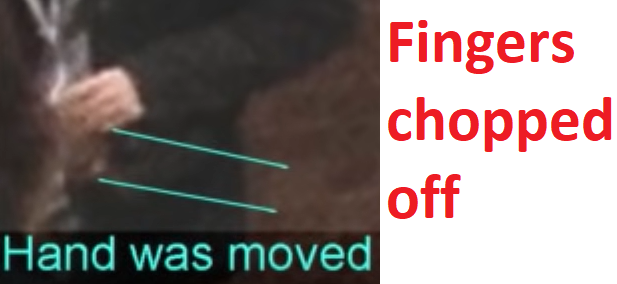

Videos: [1]
[2]
Israel vs. Daniel: [1]
Matthew 24
15 "So when you see standing in the holy place 'the abomination that causes
desolation,' spoken of through
the prophet Daniel—let
the reader understand-
16 then let those who are in
Judea
(Palestinians' West Bank)
flee to the mountains.
17 Let no one on the housetop go down to take anything out of the house.
18 Let no one in the field go back to get their cloak.
My comment: Israel will be the evil state of the anti-Christ.
Daniel's prophecy excludes Judea, and it precisely says that he will
establish his evil headquarters from
between Jerusalem and the Mediterranean sea. That's precisely
evil Israel today. Judea is in the Palestinians' West Bank. Take for
example, Jesus' birth place:
Matthew 2:1
"Now when Jesus was born in
Bethlehem of Judaea
(in the West Bank)
in the days of Herod the king, behold, there came wise men from the east to
Jerusalem,"
Matthew 24:25-27: Jesus
will return as
an Arab from
Syria. 
Habakkuk 2: GOD's future wrath upon Israel for
"spoiling"
its neighbors
(See also
Isaiah 1:9-17: Yahweh called Israel Sodom, because it spreads evil and is unjust).
and many nations.
See also:
Example of Bible verses and books about God is against Teman (pagan
Arabia), but later
"God came from Teman" [1]
and His holy one from Mecca, i.e., Islam and Prophet Muhammad.
We read this prophecy in the Bibles:
"GOD came from
Teman
and his Holy One from
Paran"
(Habakkuk
3:3).
1- Tema was one of
Ishmael's sons. It is also worth mentioning that
Arabs in the OT and NT were called
"perfect and upright"
and have
"great faith".
Not a single Jew was ever called that.
2-
Tema in Hebrew means the "south
country". We also know that Tema (Tayma) is
in Saudi Arabia today, and Saudi Arabia is indeed south of Palestine
and Jordan.
Jesus:
Spirit of Truth is Prophet Muhammad (John
16:13).
GOD's burden will be upon Arabia prophecy. The same word,
"burden," was also used for monumental assigned tasks to Prophets.
So, Arabia was chosen to carry the burden, and to bear the brunt and pain of
spreading GOD Almighty's Truth to the entire world. See
Goddess Asherah, pornography, return of the Messiah from Damascus, Bible and
Islam Prophecy for ample verses and proofs. The Prophecy also
says GOD will come from a
far southern land [1],
and from Teman and Paran [1]
(both are in Saudi Arabia). That's precisely Islam.
Arabia's burden
is an honorable burden (ample Bible verses declare this). Islam
is the perfect monotheistic Religion of Allah Almighty.
Click on
image to play video:

Becca is Mecca in Psalm 84:6.
According to (1)
Cambridge commentary,
(2)
Jewish Encyclopedia and (3)
Encyclopedia Biblica in Arabic and other sources. Ample Jewish and
Christian references declare Becca's geography to be
modern-day Mecca:

Also,
cave Hira, which the Glorious Quran was sent down in, was precisely
mentioned by the name in
Isaiah 29:12.
|
Quran's
STUNNING
Divine Miracles:
[1] |
 |
Here is one example from my
favorite Stunning Numerical and Scientific Miracles in the Glorious Quran that
are listed in
the main sections:
1-
The root for message and all of its derivatives, such as messenger and others
occurs
513
times throughout the Glorious Quran. The Prophets' and Messengers', peace
be upon them, actual names (Muhammad, Moses, Noah, Abraham, Lot etc....) were
also all combined mentioned
513 times
in the Glorious Quran. The detailed breakdown of all of this is thoroughly
listed here.
Coincidence?
See
1,000s of examples! [1].
(zip file).
Quran's Stunning Numerical & Scientific Miracles.
Stunning Prophecies [2]
[3] .jpg) 
|
Teman and Paran:
We read this prophecy in the Bibles:
"GOD came from
Teman
and his Holy One from
Paran"
(Habakkuk
3:3).
1- Tema was one of
Ishmael's sons. It is also worth mentioning that
Arabs in the OT and NT were called
"perfect and upright"
and have
"great faith".
Not a single Jew was ever called that.
2-
Tema in Hebrew means the "south
country". We also know that Tema (Tayma) is
in Saudi Arabia today, and Saudi Arabia is indeed south of Palestine
and Jordan.
3- We also know that
Paran was Mecca even before Islam. Even the Christian writings
in year
314 AD say Paran was Mecca. Also, the Jewish Samaritan Pentateuch
says Paran was Mecca.
4- We also know in
Deuteronomy 18:18, GOD will send the Israelites a
Prophet from their
"brothers"
[2].
That's the Ishmaelites. Ample verses also provided where the same word was
also used for
cousins.
Isaac and Ishmael were brothers, and their sons are cousins. Also visit:
The prophecy of the
10,000 Muslims
(Isaiah
56:5: Muslim is the future believers' name.
Sons and daughters titles will be "no
more") who liberated Mecca
(Paran) in the Bible (Luke
2:52:
GOD forgave Jesus' sins
and was "charitable" with him).
In the OT and renewed in the NT. Also, the Bible's 3 Babylons thoroughly
discussed here.
Jesus:
Spirit of Truth is Prophet Muhammad (John
16:13).
Isaiah prophecy:
House of GOD desert
of Kedar">
House of GOD will be
built in the desert of Kedar. Kedar was one of Ishmael's sons.
Isaiah 29:
Mentions Islam's
cave Hira
(χιρα),
Quran revelation in it & unlettered Prophet Muhammad.
Matthew 24:25-27: Jesus
will return as
an Arab from
Syria.
Becca is Mecca in Psalm 84:6.
According to (1)
Cambridge commentary,
(2)
Jewish Encyclopedia and (3)
Encyclopedia Biblica in Arabic and other sources. Ample Jewish and
Christian references declare Becca's geography to be
modern-day Mecca.
Tribes of Teman:
5-
So Teman here references what was then
a vast region
in Arabia that encompassed the
tribes of Teman and the lands of Paran. Both Teman and
Paran are linked together in
Habakkuk 3:3.
The context encompasses both of them.
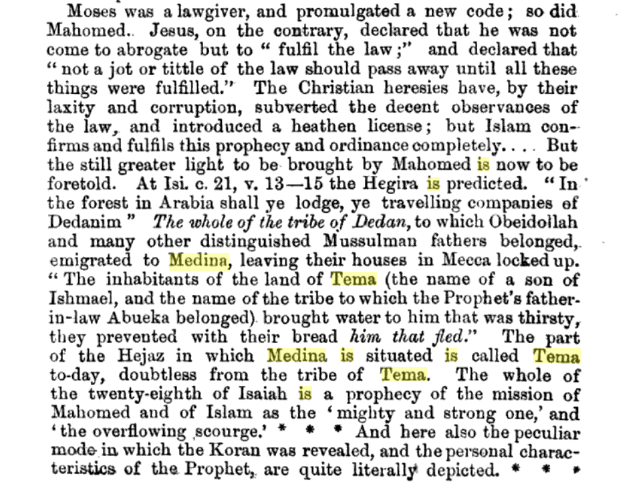
"Moses was a lawgiver, and promulgated a new code; so did Mahomed. Jesus,
on the contrary, declared he was not come to abrogate but to "fulfill the law;"
and declared that "not a jot or little of the law should pass away until all
these things were fulfilled." The Christian heresies have, by their laxity
and corruption, subverted the decent observances of the law, and introduced a
heathen license; but Islam confirms and fulfills this prophecy and ordinance
completely.... But the still greater light to be brought by Mahomed is now to be
foretold. At Isi. c. 21, v. 13-15 the Hegira is predicted. "In the
forest in Arabia shall ye lodge ye travelling companies of Dedanim" The
whole of the tribe of Dedan, to which Obeidollah and many other distinguished
Mussulman fathers belonged,
emigrated to Medina, leaving their houses in Mecca locked up.
"The inhabitants of the land of Tema (the name of a son of
Ishmael, and the name of the tribe to which the Prophet's father-in-law Abueka
belonged) brought water to him that was thirsty, they prevented with their bread
him that fled." The part of the Hijaz in which Medina is situated is
called Tema to-day, doubtless from the tribe of Tema. The whole of the
twenty-eighth of Isaiah is a prophecy of the mission of Mahomed and of Islam as
the 'mighty and strong one,' and 'the overflowing scourge.' * * * And here also
the peculiar mode in which the Koran was revealed, and the personal
characteristics of the Prophet, are quite literally depicted. * * *"
Source:
The
Bible and Its Evidences. (Second Edition, Revised and Enlarged), By
Robert Cooper (secularist).
Pagan-Teman vs. Islam-Teman:
During the pagan times during Nebuchadnezzar, King Darius and others' times,
Teman was a pagan land and people. But later, GOD Almighty's Islam and
Prophet Muhammad were to come from Teman and Paran and change Arabia and all
nations forever:
[1]
[2]
Ezekiel 25
13 therefore this is what the Sovereign Lord says: I will stretch out my hand
against Edom and kill both man and beast.
I will lay it waste, and from Teman to Dedan
they will fall by the sword.
Amos 1
12 I will send fire on Teman
that will consume the fortresses of Bozrah.”
Obadiah 1
9 Your warriors,
Teman, will be terrified, and everyone in Esau’s mountains will
be cut down
in the slaughter.
Then later:
Habakkuk 3
3
God came from Teman,
the Holy One from Mount
Paran.
His glory covered the heavens and his praise filled the earth.
Also visit:
Jesus:
Spirit of Truth is Prophet Muhammad (John
16:13).
GOD's burden will be upon Arabia prophecy. The same word,
"burden," was also used for monumental assigned tasks to Prophets.
So, Arabia was chosen to carry the burden, and to bear the brunt and pain of
spreading GOD Almighty's Truth to the entire world. See
Goddess Asherah, pornography, return of the Messiah from Damascus, Bible and
Islam Prophecy for ample verses and proofs. The Prophecy also
says GOD will come from a
far southern land [1],
and from Teman and Paran [1]
(both are in Saudi Arabia). That's precisely Islam.
Arabia's burden
is an honorable burden (ample Bible verses declare this). Islam
is the perfect monotheistic Religion of Allah Almighty.
Click on
image to play video:
Becca is Mecca in Psalm 84:6.
According to (1)
Cambridge commentary,
(2)
Jewish Encyclopedia and (3)
Encyclopedia Biblica in Arabic and other sources. Ample Jewish and
Christian references declare Becca's geography to be
modern-day Mecca.
Are you the Prophet?
6- In the New Testament, we read
about how the
Jews had prophecies about the following servants still yet to come:
1. Elijah.
2. The Messiah.
3. The Prophet.
John 1:19-21
and
John 7:40-44. Click on the images to expand:
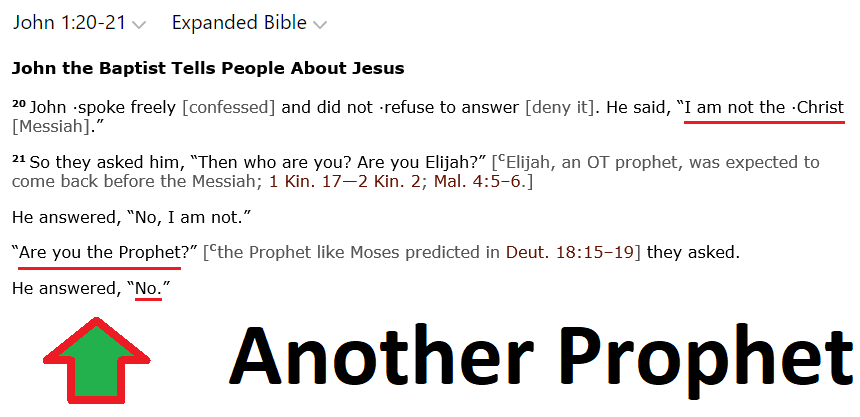

John 1
John the Baptist Tells People About Jesus
19 Here is the ·truth John told [testimony John gave; witness of John; 1:6] when
the leaders [Jewish leadership; Jews; John often uses the term "Jews" to refer
to the religious leaders in opposition to Jesus, rather than to the Jewish
people generally] in Jerusalem sent priests and Levites [the religious
authorities; priests oversaw temple worship; Levites were members of the tribe
of Levi who assisted them; 1 Chr. 23:24-32] to ask him, "Who are you?"
20 John spoke freely [confessed] and did not refuse to answer [deny it]. He
said, "I am not the Christ
[Messiah]."
21 So they asked him, "Then who are you?
Are you Elijah?" [Elijah, an OT prophet, was expected to come
back before the Messiah; 1 Kin. 17-2 Kin. 2; Mal. 4:5-6.]
He answered, "No, I am not."
"Are you the Prophet?" [the Prophet like
Moses predicted in Deut. 18:15-19] they asked.
He answered, "No."
Notice here how Christ, Elijah and the Prophet are three different persons.
John 7
The People Argue About Jesus
40 When the people heard Jesus' words, some of them said, "This
man really is the Prophet
[1:21; the "prophet like Moses" of Deut. 18:15-18]."
41 Others said, "He is the Christ
[Messiah]." Still others said, "The Christ [Messiah] will not come from Galilee.
42 The Scripture says that the Christ [Messiah] will come from David's family
[offspring; seed; 2 Sam. 7:12-16; Ps. 89:3-4; Is. 9:7; 55:3] and from Bethlehem,
the town [village] where David lived [Mic. 5:2]."
43 So the people did not agree with each other [there was a division in the
crowd] about Jesus (Luke
2:52:
GOD forgave Jesus' sins
and was "charitable" with him).
44 Some of them wanted to arrest [seize] him, but no one was able to touch [lay
a hand on] him.
They lied:
1- The writers of the NT lied and said that Jesus is both the
Messiah and the Prophet. But this is a lie, because the Prophet in the OT
was to come from
Arabia, while the Messiah was to come from
Bethlehem, Palestine. Two different persons in two different
geographies. For example:
Was Jesus from Paran?
Was Jesus from Teman?
Was Jesus from the desert of Kedar? Isaiah prophecy:
House of GOD desert
of Kedar">
House of GOD will be
built in the
desert of Kedar. Kedar was one of Ishmael's sons.
Was Jesus from the Israelites'
brothers
[2],
the Ishmaelites?
Was Jesus the unlettered Prophet that received his Divine Revelation in Cave
Hira in Mecca?
Isaiah 29:
Mentions Islam's
cave Hira
(χιρα),
Quran revelation in it & unlettered Prophet Muhammad.
Was it Jesus or Islam that fulfilled these? For ample more proofs please
visit:
www.answering-christianity.com/luke6_40.htm
Yahweh is Baal to the Jews in Isaiah 54:5 and
Hosea 2:16. Exposing the Christians' pagan-god Baal lie.
Muslims
(Isaiah
56:5: Muslim is the future believers' name.
Sons and daughters titles will be "no
more")
bless
Abraham everyday. Shedding light on
Genesis 12:1-3 "I will bless those who bless
you...".
Did you know that Elohim is Allah [1,
*] [2]
[3].
The "im" in Hebrew is a majestic plural for GOD Almighty. The root Word is
"Eloh". And the more original Jews such as Yemenites and others say
Alohim or Alah-im. And when you yourself pronounce it, you do
naturally pronounce it
with a double "l": Allah. Jews do call Him: Allah-im.
Aramaic-speaking people also call GOD Almighty
Allah. See the following videos for Biblical references and proofs.
Also,
pre-Islamic Biblical archeological findings have GOD Almighty as
"Allah". So the Original Holy Name for GOD Almighty is not Eloh.
It is Allah! Eloh is a Hebrew dialect, which not all Hebrew
speakers use anyway. Allah had always been the Original and Universal GOD
Almighty even before birth of Judaism, and the existence Hebrew. And
Hebrew is a developed language from Phoenician. See the following links:
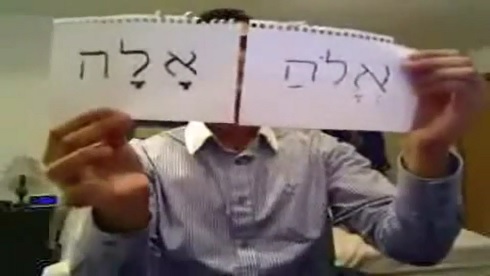
(Click to play
videos)
Daniel 3:26 in Aramaic says "Servants of Allah (GOD Most High GOD)".
https://en.wikipedia.org/wiki/Phoenician_alphabet
https://en.wikipedia.org/wiki/Biblical_Hebrew
Yahweh is Baal to the Jews in Isaiah 54:5 and
Hosea 2:16.
Exposing the Christians' pagan-god Baal lie.
Know also that the entire
"House of Jacob", in Isaiah's
prophecy, was commanded to follow this Servant-to-come from the deserts of
Arabia [1].
Do not be afraid (Isaiah 41:8-13) of this new GENTILE SERVANT
(Isaiah 41:2, 42:1) and the
NEW CHANGE
(he will sing a NEW SONG of new Divine Revelation Isaiah 42:10) that the
desert of Kedar will rejoice for his coming (Isaiah 42:11).
Never was this said for an Israelite Prophet. THE ENTIRE HOUSE OF JACOB
were commanded to not be afraid of him, because he will be
a NON-ISRAELITE Prophet.
NEW SONG here means a new non-Hebrew Arabic Scripture to come from
Arabia (Kedar); the Glorious Quran.
Jesus:
Spirit of Truth is Prophet Muhammad (John
16:13).
Keep in mind also that the NT's gospels and books were
written around 80 to 300
years after Jesus' departure. Most if not all of the disciples were
already dead. The Bible's own theologians admit that almost all of the
Bible's gospels and books:
Do contain alterations, fables and man-made injections in them.
Written by mysterious men.
Written by an unknown number of men.
Written in unknown places.
Written in unknown dates.
2- GOD of
Abraham, Isaac and Jacob only? Yet, GOD also came from the deserts of
Teman and Kedar, and even established His House in the desert of Kedar.
See also:
Example of Bible verses and books about God is against Teman (pagan
Arabia), but later
"God came from Teman" [1]
and His holy one from Mecca, i.e., Islam and Prophet Muhammad.
Jesus:
Spirit of Truth is Prophet Muhammad (John
16:13).
GOD's burden will be upon Arabia prophecy. The same word,
"burden," was also used for monumental assigned tasks to Prophets.
So, Arabia was chosen to carry the burden, and to bear the brunt and pain of
spreading GOD Almighty's Truth to the entire world. See
Goddess Asherah, pornography, return of the Messiah from Damascus, Bible and
Islam Prophecy for ample verses and proofs. The Prophecy also
says GOD will come from a
far southern land
[1],
and from Teman and Paran [1]
(both are in Saudi Arabia). That's precisely Islam.
Arabia's burden
is an honorable burden (ample Bible verses declare this). Islam
is the perfect monotheistic Religion of Allah Almighty.
Becca is Mecca in Psalm 84:6.
According to (1)
Cambridge commentary,
(2)
Jewish Encyclopedia and (3)
Encyclopedia Biblica in Arabic and other sources. Ample Jewish and
Christian references declare Becca's geography to be
modern-day Mecca.
3- Who was
the sacrificed son? [1]
[2]
Ample evidence from the Bible clearly says that it was Ishmael.
Quran Miracle:
The Jews' and Christians' scribes
changed and still change
the Words.
Proven with images, text and videos from their corrupt bible and books!
See how they removed words and altered words.
Bible says that Jews' from
their
essence were liars
(See also
Isaiah 1:9-17: Yahweh called Israel Sodom, because it spreads evil and is unjust).
From their
"birth"
they were liars the Old Testament declares them. This is another proof
that the Bible is full of man-made corruption and fabrications, especially in
the Jews' ancient history and stories. Jeremiah 8:8 is thoroughly covered
here.
Jews' dogs: Jesus ended the Arabs being the Jews' dogs.
He said that Arabs have
"great faith". This is why he will
return from the Arabs according to the Bible and Islam.
For ample more details, visit:
www.answering-christianity.com/godtitle.htm
www.answering-christianity.com/convert_christians.htm
www.answering-christianity.com/son_of_god.htm
www.answering-christianity.com/blog/index.php?topic=1904.msg7673#msg7673
www.answering-christianity.com/john20_28.htm
www.answering-christianity.com/jesus_had_no_will.htm
www.answering-christianity.com/jesus_miracles.htm
(non of Jesus' Miracles were unique)
www.answering-christianity.com/ac7.htm#links
www.answering-christianity.com/jesus_called_slave_in_bible.htm
Trinity Crucified!
100s of verses prove trinity is false.
Jesus healed others only after getting permissions from GOD Almighty.
His wishes were sometimes
denied.
[1]
[2].
Becca is Mecca in Psalm 84:6.
According to (1)
Cambridge commentary,
(2)
Jewish Encyclopedia and (3)
Encyclopedia Biblica in Arabic and other sources. Ample Jewish and
Christian references declare Becca's geography to be
modern-day Mecca:
|